
Download The


F2 RETAINED CANOLA SEED
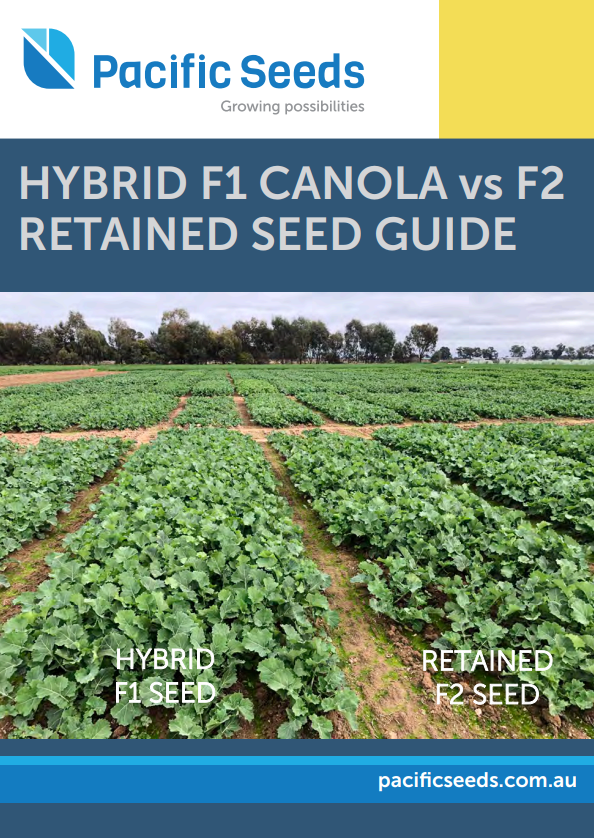
F2 generations grown out from F1 hybrids segregate out for all observable and measurable traits to different extents depending the Hybrid parent combination and environmental conditions.
The variability in the F2 segregates in both observed and measured changes in agronomic traits have adverse effects on plant vigour, DM production, flowering uniformity, sterility, blackleg resistance, lodging resistance, plant height uniformity, oil content and their combined effects on reducing grain yields.
Blending F1 & F2 seed may reduce the "significant yield downside" from just growing F2 generation seed only (proportion of each "may" drive the relative loss value equation), however, your crop will also still experience all the agronomic segregation issues that F2 plants demonstrate with establishment, Oil% and quality parameters, disease resistance, sterility, lodging, height and flowering timing.
Another consideration for retaining F2 seed on farm is the potential for unknown or unforeseen seed vigour or weed seed hygiene quality parameters that may not be at suitable standards for sowing.
F2 RETAINED CANOLA SEED
RESEARCH TRIAL OUTCOMES
Farmer retained F2 seed will segregate for different traits depending on how physiologically and the difference in parental physiology affects successive progeny or generations by exhibiting:
- PLANT VIGOUR - Early seedling vigour can be lower in some plants in the F2 generation with 10-15% lower overall establishment, 15-30% lower DM production, which can also lead to reduced crop canopy competitiveness.
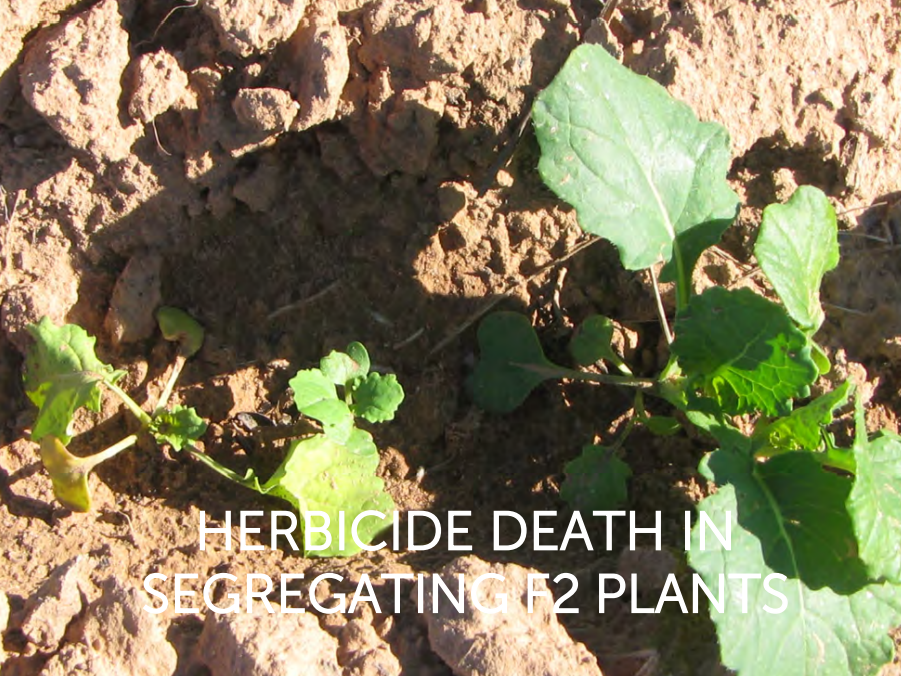
- HERBICIDE TOLERANCE - Some plants are resistant or tolerant to chemical and some susceptible depending on the specific herbicide tolerance trait. With the Roundup Ready® or TruFlex® system, depending on the specific hybrid parents, F2 generation plants will also have up to 25% death of plants as they segregate for tolerance to glyphosate.
- FLOWERING UNIFORMITY - F2 generation shows a mixture of early flowering to late flowering plants and at windrowing time a mixture of plants flowering, podding and shattering which is a result of the different flowering maturities of the two parents in the hybrid. Hybrid F1’s showed 50% flowering within 2 days whereas the F2 retained generation seed had a 10–14-day variation in plant segregates. Other than machinery operational difficulties, seed yields and oil contents could be significantly affected by a larger flowering window.
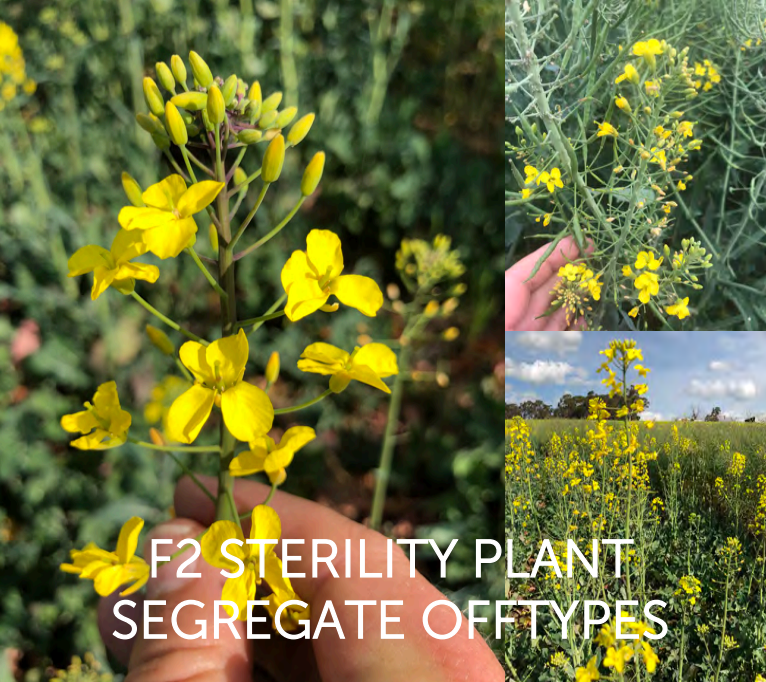
- PLANT FERTILITY - Hybrid F1’s showed 98-100% fertility whereas the F2 retained seed has (up to a 25%) being ‘male sterile’ (no pollen) and some remain fertile. The effect of this on potential grain yield is affected by rainfall events, insect activity, temperatures, cloud cover, available viable pollen and relative humidities during the canola flowering cycle.
- PLANT HEIGHT - F2 plants demonstrate mixed and variable levels of taller and shorter plants due to the segregation process. This could lead to difficulties with spraying, windrowing and harvesting operations.
- PLANT LODGING - Hybrid F1’s measured excellent lodging resistance whereas the F2 retained seed plants has exhibited up to 10% increase in stem lodging.
- BLACKLEG REACTIONS - Hybrid F1’s with higher blackleg ratings maintained high blackleg reaction with low canker levels whereas the F2 retained seed was observed having up to 15% adult stem cankers, as well as up to 20% higher plant mortality. Grain yields could be significantly affected, and it would be much more difficult to manage blackleg levels in the crop using seed treatments, in-crop sprays and crop rotational strategies.
- GRAIN OIL CONTENT - Harvested F2 retained seed when harvested as grain has demonstrated between 0.5 to 2.5% decrease in grain oil% when compared to hybrid F1 plants.
INDUSTRY CANOLA RESEARCH TRIAL
F1 VS F2 GRAIN YIELD RESULTS
INTERNATIONAL RESULTS
The higher cost of hybrid (HY) F1 canola (Brassica napus L.) seed has some producers considering F2 generation hybrid farm-saved seed (HY-FSS), or open-pollinated (OP) varieties (both certified and farm-saved seed).
The net return (NR) of different varieties, genetic backgrounds, seeding rates, seed treatments, and seed sizing was evaluated from three experiments over eight site-years of field data from western Canada.
The NR accounted for yield, green seed price discount, seed costs, and other production costs. Analysis of variance indicated F1 hybrid seed (HYC) was more profitable than HY-FSS (15%, P - 0.0057) and OP (22%, P - 0.0001).
Higher seeding rates and seed sizing for HY-FSS did not increase NR compared to HYC. The findings of this study support the use of HYC canola seed, especially at high canola prices. Canola producers will not increase their NR by using HY-FSS or OP seed to reduce their seed cost because the lost value of production exceeds the higher cost of HYC seed.
AUSTRALIAN RESULTS
Results below quoted from different industry businesses across Australia:
- Pacific Seeds (2020-21) - Winter CL Hybrid F1 provided
15-45% higher yields or $240-720/ha higher GR (@2t/ha - $800/MT)
compared to F2 retained seed.
- DPIRD WA (2014-2015) - Spring TT hybrids provided up to
19% higher yields and $122/ha higher GR $/ha compared to the F2
retained generation
- SARDI (2009-2012) - Spring CL and Conventional hybrids
provided 22 to 33% higher yields compared to the F2 retained
generation. - Pacific Seeds (2009-2010) Spring CL, TT and CNV hybrid F1
provided 10-35% higher yields or $260-430/ha higher GR
compared to F2 retained seed.
WEBSITE REFERENCE LINKS FOR FURTHER INFORMATION
https://www.pacificseeds.com.au/wp-content/uploads/2020/07/Hyola-970CL-vs-F2-Retained-Seed.pdf
https://www.syngentacropprotection.com/assets/assetlibrary/canada_canolafacts11.pdf
http://www.australianoilseeds.com/__data/assets/pdf_file/0005/7448/
GRDC_FS_HybridCanola.pdf
https://www.agric.wa.gov.au/canola/can-agronomy-overcome-yield-penalty-retained-f2-hybrid-tt-canolalow-rainfall-zone-grass
https://www.researchgate.net/
publication/240783653_The_Profitability_of_Seeding_the_F_Generation_of_Hybrid_Canola
http://www.australianoilseeds.com/__data/assets/pdf_file/0019/7426/
Victorian_2010_BO_TRIAL.pdf
https://grdc.com.au/__data/assets/pdf_file/0023/370391/Canola-agronomy-research-in-Western-Australiabulletin-4986.pdf?%
20utm_source=website&utm_medium=download_link&utm_campaign=pdf_download&utm_ter m%
20=West&utm_content=Canola%20agronomy%20research%20in%20Western%20Australia
https://grdc.com.au/__data/assets/pdf_file/0028/369316/GrowNote-Canola-South-3-Planting.pdf
The information provided in this publication is intended as a guide only. Advanta Seeds Pty Ltd (including its officers, employees, contractors and agents) (‘Advanta Seeds’) can not guarantee that every statement is without flaw of any kind. While Advanta Seeds has taken all due care to ensure that the information provided is accurate at the time of publication, various factors, including planting times and environmental conditions may alter the characteristics and performance from plants. Advanta Seeds shall not be liable for any errors or omissions in the information or for any loss, injury, damage or other consequence whatsoever that you or any person might incur as a result of your use of or reliance upon the products (whether Advanta Seeds products or otherwise) and information which appear in this publication. To the maximum extent permitted by law, the liability of Advanta Seeds for any claim whatsoever arising out of the supply or use of or reliance upon the products and information in this publication (including liability for breach of any condition or warranty implied by the Trade Practices Act 1974 or any other law) is limited at its discretion, to the replacement of the products, the supply of equivalent products or the resupply of the publication. For application to specific conditions, seek further advice from a local professional. ©Advanta Seeds 2021.